
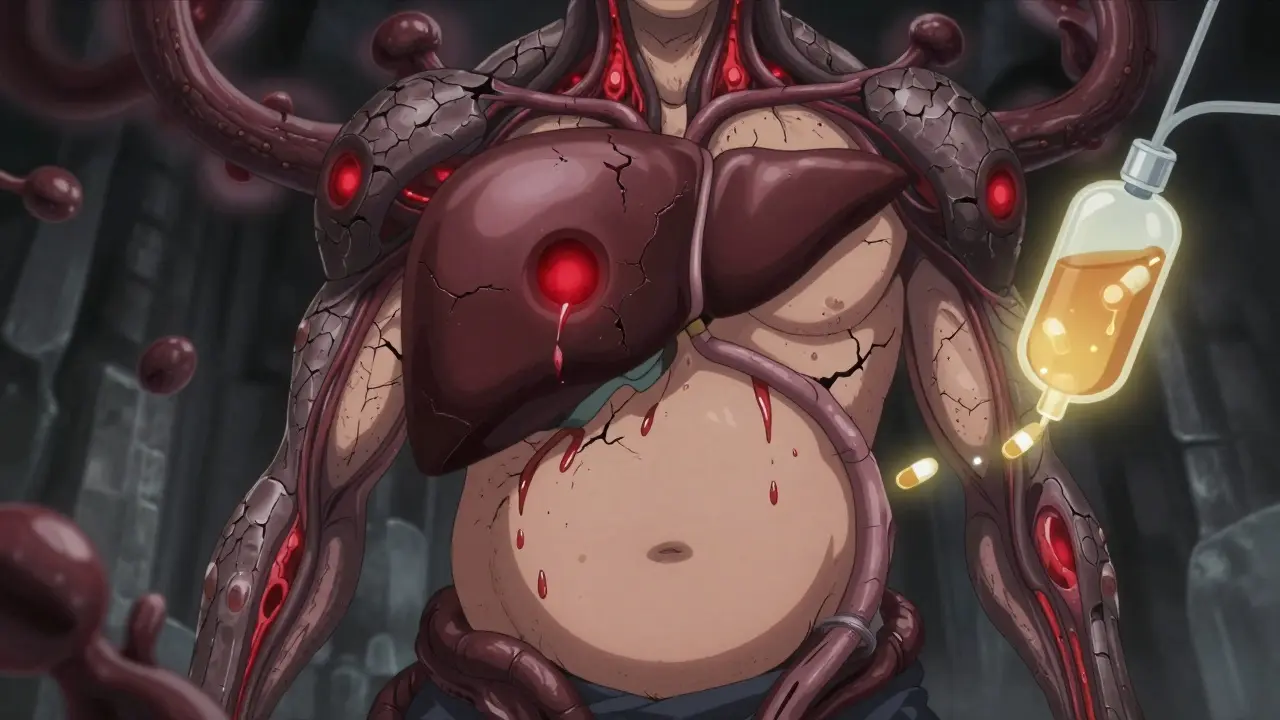
When the liver gets damaged over time, it doesn’t heal the way other organs do. Instead of repairing itself, it builds scar tissue. This scar tissue doesn’t work. It doesn’t filter toxins. It doesn’t make proteins. It doesn’t store energy. And as more and more healthy tissue turns to scar, the liver starts to fail. That’s cirrhosis - the final stage of chronic liver disease. It’s not a single disease. It’s the result of years of damage from alcohol, hepatitis, fatty liver, or other causes. And once it happens, the damage is permanent. But that doesn’t mean nothing can be done. Knowing what complications to watch for - and how to manage them - can mean the difference between staying at home and ending up in the hospital.
What Happens When the Liver Starts to Fail?
The liver is one of the most resilient organs in the body. It can handle a lot before showing signs of trouble. That’s why many people with early cirrhosis feel fine. No pain. No jaundice. No swelling. But inside, things are changing. Blood flow through the liver gets blocked. Pressure builds up in the portal vein - the main vessel that carries blood from the gut to the liver. This is called portal hypertension. And once that pressure hits 10 mmHg or higher, it triggers a chain reaction of problems.That’s when the real complications start. Fluid leaks out of blood vessels into the abdomen - that’s ascites. Blood vessels in the esophagus swell and burst - that’s variceal bleeding. Toxins that should be filtered out start building up in the brain - that’s hepatic encephalopathy. And the risk of liver cancer rises. Each of these isn’t just a symptom. It’s a sign the liver is losing its grip.
Key Complications and What They Mean
Ascites - fluid in the belly - affects about half of people with cirrhosis within 10 years. It doesn’t just make you look swollen. It can make breathing hard, cause pain, and lead to infection. Spontaneous bacterial peritonitis (SBP) is a dangerous infection of that fluid. It kills 20-40% of people who get it during their first hospital stay. The fix? Low-sodium diet - under 2 grams a day - and diuretics like spironolactone. But even then, 1 in 10 people develop refractory ascites. That means the fluids keep coming back no matter what. Then the only option is a procedure called large-volume paracentesis - draining up to 5 liters of fluid at a time. And even then, you need albumin infusion to keep your blood pressure stable.
Variceal bleeding is even more urgent. When portal pressure rises, veins in the esophagus stretch like overfilled balloons. They can rupture without warning. Bleeding from these veins kills 15-20% of people during the first episode. That’s why everyone with cirrhosis gets an endoscopy to check for these veins. If they’re found, treatment starts right away: a beta-blocker like propranolol or nadolol to lower pressure, and sometimes banding to tie off the veins. But even with treatment, 60% of people who don’t stay on medication will bleed again within a year.
Hepatic encephalopathy is harder to spot. It starts with forgetfulness. Then confusion. Then slurred speech. Some people become agitated. Others slip into a coma. It’s caused by ammonia and other toxins the liver can’t remove. The standard treatment is lactulose - a laxative that flushes out toxins through the gut. But it’s not easy. One patient on Reddit said, “The constant diarrhea makes social life impossible - I’ve missed 12 family events this year.” Rifaximin, an antibiotic that works in the gut, helps reduce hospitalizations by nearly 60% for those who keep having episodes.
And then there’s liver cancer. About 2-8% of people with cirrhosis develop hepatocellular carcinoma each year. That’s why every person with cirrhosis needs an ultrasound every six months. Catching it early - when the tumor is still small - means surgery or transplant is still possible. Without screening, most tumors are found too late.

How Doctors Measure How Bad It Is
Not all cirrhosis is the same. That’s why doctors use scoring systems to predict survival and decide who needs a transplant. The two most common are Child-Pugh and MELD.
Child-Pugh looks at five things: bilirubin (a liver enzyme), albumin (a protein), INR (a blood clotting test), ascites, and brain function. Each gets a score. Add them up. Class A (5-6 points) means you’re doing okay - 100% survive a year. Class C (10-15 points) means you’re in trouble - only 45% survive a year.
MELD is more precise. It uses three lab values: bilirubin, creatinine (kidney function), and INR. The higher the score, the sicker you are. A score of 15 or higher means you’re at serious risk. Most transplant centers use MELD to prioritize who gets a liver. But here’s the problem: someone with constant brain fog from encephalopathy might have a low MELD score. They’re suffering. They’re not working. They’re not living. But they’re not at the top of the list. That’s why new rules in 2024 now include quality-of-life measures alongside MELD.
Managing Cirrhosis - What Actually Works
There’s no magic cure. But there are clear, evidence-backed steps that make a real difference.
- Stop alcohol - no matter what caused the cirrhosis. If you’re still drinking, you’re making it worse. Abstinence is the single most effective thing you can do.
- Treat the cause - if it’s hepatitis C, antivirals like glecaprevir/pibrentasvir cure it in 95% of cases. If it’s fatty liver (now called MASH), weight loss and the new drug resmetirom (Rezdiffra) can reduce scarring.
- Take your meds - beta-blockers for varices, lactulose or rifaximin for encephalopathy. Missing doses increases your risk of hospitalization.
- Watch your salt - less than 2 grams a day. That means no processed food, no canned soup, no chips. Read labels. Cook at home.
- Get screened - ultrasound every 6 months. Don’t skip it. Early cancer saves lives.
And don’t forget support. A multidisciplinary team - hepatologist, dietitian, social worker, addiction counselor - improves adherence and cuts ER visits by 40%. One study found that patients with regular nurse follow-ups had 32% fewer readmissions.
What’s New in 2025
The field is moving fast. In March 2024, the FDA approved resmetirom (Rezdiffra) for MASH-related cirrhosis. In a year-long trial, it reduced liver scarring in over 20% of patients. That’s huge - the first drug shown to reverse fibrosis in this group.
Artificial intelligence is stepping in too. An algorithm called CirrhoPredict analyzed routine blood tests and predicted which patients would decompensate within 90 days - with 88% accuracy. That means doctors can act before you get sick.
And transplant policies are changing. The new Continuous Distribution Framework doesn’t just look at how sick you are - it looks at how much you’re suffering. Someone with recurrent encephalopathy might now move up the list faster.
Researchers are even testing drugs that might reverse cirrhosis. Galectin-3 inhibitors, in early trials, showed 18% reduction in liver scarring. The goal? By 2030, to reverse early cirrhosis in 40% of patients.
The Human Side - What Patients Really Live With
Behind every statistic is a person. One survey found 78% of cirrhosis patients struggle with fatigue so bad they can’t work. Another 65% say they have “brain fog” that makes it hard to think clearly. For those with ascites, 73% say the paracentesis procedure hurts - a 5 or higher on a 10-point scale.
But there’s hope. One Reddit user, “SecondChance99,” wrote: “18 months post-transplant, my MELD score dropped from 28 to 9 and I returned to full-time work.” That’s the power of timely intervention.
It’s not just about surviving. It’s about living. And that means catching problems early, sticking to treatment, and having the right support.




Ian Kiplagat
March 8, 2026 AT 08:31Amina Aminkhuslen
March 8, 2026 AT 14:55amber carrillo
March 8, 2026 AT 15:48Tim Hnatko
March 9, 2026 AT 16:28Joey Pearson
March 9, 2026 AT 18:01Roland Silber
March 11, 2026 AT 00:53Patrick Jackson
March 11, 2026 AT 14:38Adebayo Muhammad
March 13, 2026 AT 13:40Pranay Roy
March 13, 2026 AT 21:45Joe Prism
March 15, 2026 AT 07:30Bridget Verwey
March 16, 2026 AT 03:27Andrew Poulin
March 17, 2026 AT 01:32Weston Potgieter
March 18, 2026 AT 19:04Vikas Verma
March 19, 2026 AT 00:32Sean Callahan
March 19, 2026 AT 15:04