

Many people don’t realize that taking prescribed opioids can make it just as dangerous to drive as drinking alcohol. Even if your doctor says it’s safe, the law and your body don’t always agree. Opioids - whether it’s oxycodone, hydrocodone, fentanyl, or morphine - slow down your brain’s ability to react, judge distance, and stay alert. The result? A higher chance of crashing. In fact, studies show that driving while on opioids can doubly increase your risk of a crash. And in many places, you can get arrested for it - even if you’re taking your medication exactly as prescribed.
Why Opioids Make Driving Dangerous
Opioids don’t just relieve pain. They also affect your central nervous system in ways that directly interfere with driving skills. The National Institute on Drug Abuse (NIDA) confirms that opioids cause drowsiness, dizziness, and trouble thinking clearly. These aren’t vague side effects - they’re measurable impairments. A 2022 study from the National Safety Council found that even therapeutic doses of prescription opioids can impair driving ability to the same level as a blood alcohol concentration (BAC) of 0.05%. That’s above the legal limit in many countries and close to the U.S. limit of 0.08%.
Unlike alcohol, where you can usually tell someone’s drunk by slurred speech or unsteady walking, opioid impairment is quieter. People on opioids might seem fine - no stumbling, no smell of alcohol - but their reaction time is slower, their focus is scattered, and their judgment is clouded. One driver in a Reddit thread described driving home after taking oxycodone: “I felt fine. Then the officer asked me to walk a line. I couldn’t do it. I didn’t even realize how messed up I was.”
Legal Consequences: It’s Not Just About Illicit Drugs
Many assume that if a doctor prescribed the opioid, they’re protected from legal trouble. That’s a dangerous myth. In the U.S., 16 states have zero-tolerance laws for drugs, meaning any detectable amount of an opioid in your system while driving can lead to charges. Five states have per se laws that set specific legal limits for opioids, similar to how 0.08% BAC is the limit for alcohol. Canada treats opioid impairment the same as drunk driving under its Criminal Code - no exceptions for prescriptions.
Even in states that allow a defense based on having a valid prescription, the burden of proof is on you. In Wisconsin, you must prove by a preponderance of evidence that you were taking the drug as prescribed. In Utah, you can argue the drug was prescribed - but you still need to prove you weren’t impaired. And in Georgia, drivers under 21 can claim “therapeutically appropriate amounts,” but that’s not a guarantee.
Real cases show how easily things go wrong. One man in California was pulled over after swerving lanes. He had a prescription for hydrocodone. He told the officer he’d taken it as directed. He still got a DUI. His defense? He didn’t know the warning label said “Do Not Operate Heavy Machinery.” He hadn’t read it. His pharmacy didn’t warn him. He lost his license for six months and paid over $12,000 in legal fees.
The Hidden Gap: Doctors Don’t Always Warn Patients
A 2022 survey of 1,247 chronic pain patients by the Pain News Network found that 63% didn’t know driving on prescribed opioids could lead to a DUI. Nearly 30% admitted they’d driven within an hour of taking their dose. Why? Because many doctors don’t bring it up. The National Safety Council found that 72% of patients prescribed opioids received no meaningful counseling about driving risks. Pharmacists, too, are often too busy to explain the full picture.
One user on Drugs.com wrote: “My pharmacist told me it was fine to drive. The label says not to. I got a DUI. Now I have a criminal record.” This isn’t rare. Patients rely on trusted professionals - but the system isn’t set up to catch these gaps.
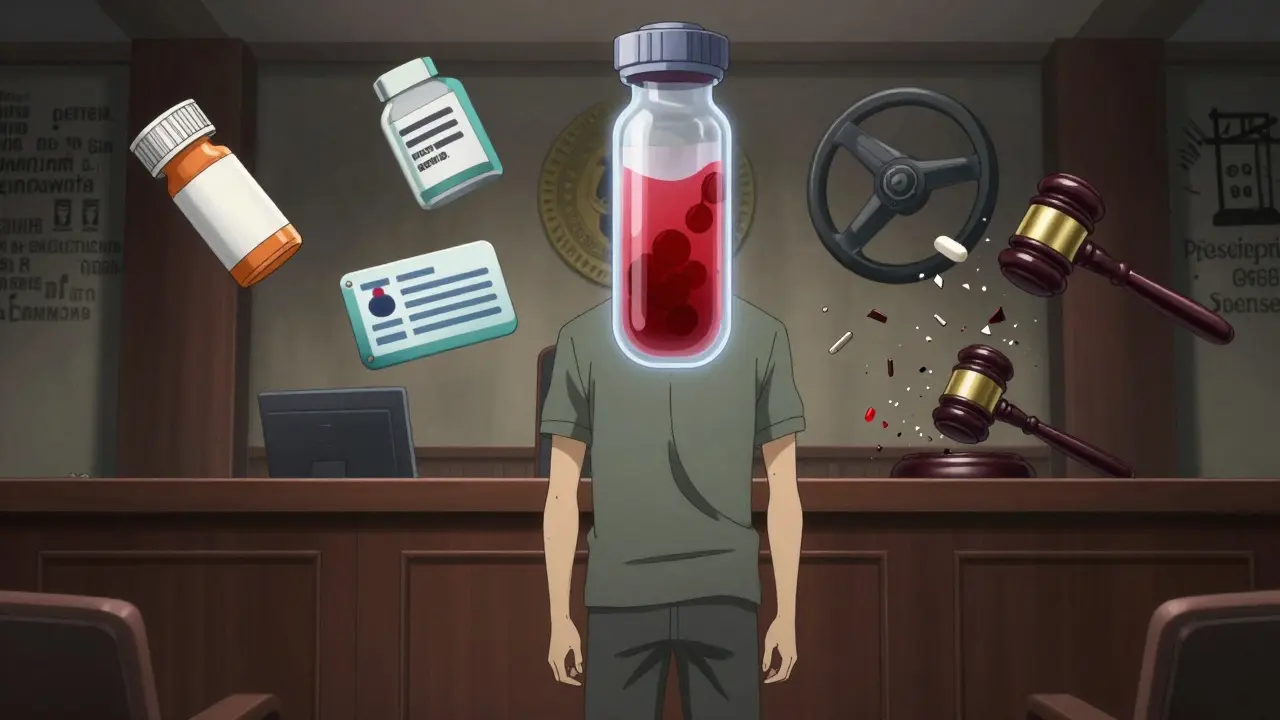
How Long Should You Wait Before Driving?
There’s no universal answer. It depends on the drug, the dose, your metabolism, and whether it’s immediate-release or extended-release. The Mayo Clinic offers practical guidance:
- Immediate-release opioids (like oxycodone or hydrocodone tablets): Wait at least 3 to 4 hours after taking a dose.
- Extended-release opioids (like OxyContin or MS Contin): Wait 6 to 8 hours - sometimes longer.
But even waiting isn’t foolproof. Some people metabolize drugs slower. Others feel drowsy even after waiting. The safest rule? If you feel even slightly foggy, dizzy, or tired - don’t drive. Your body doesn’t lie.
What Happens if You’re Stopped?
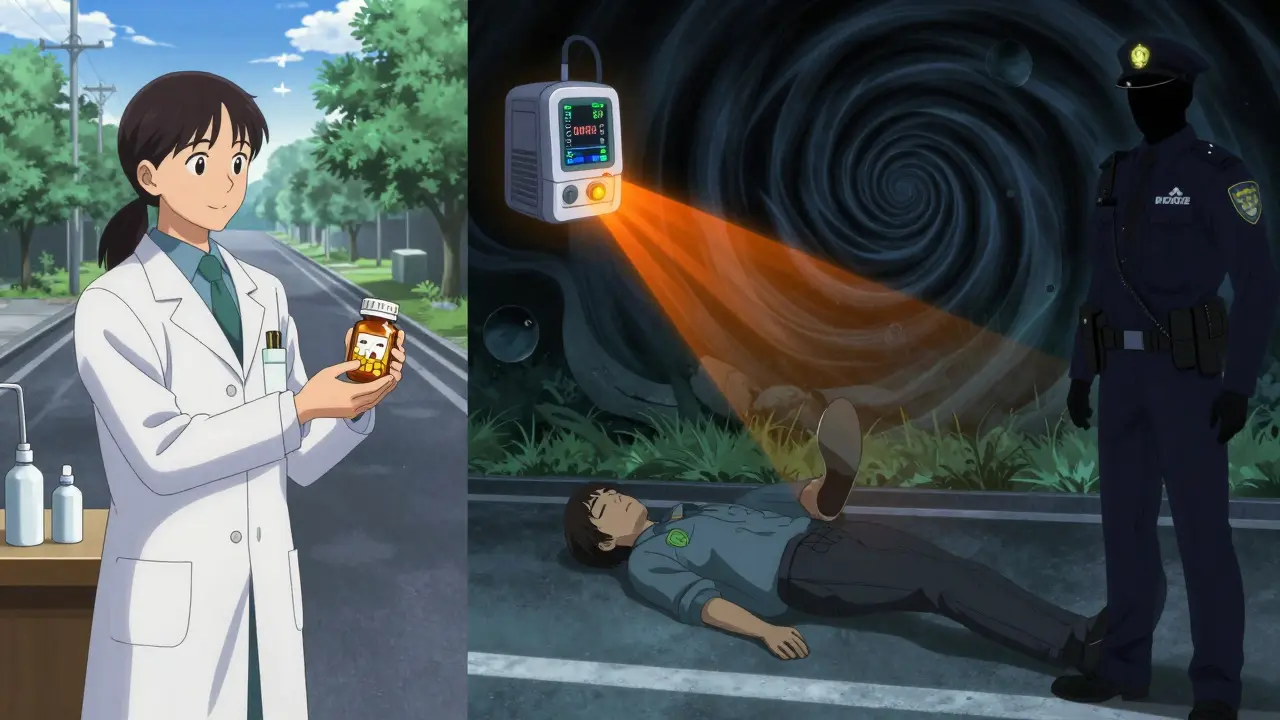
Police don’t use breathalyzers for opioids. Instead, they use Standardized Field Sobriety Tests (SFST) - walking heel-to-toe, standing on one leg, following a pen with your eyes. If you fail, they’ll likely call a Drug Recognition Expert (DRE). These are officers specially trained to identify drug impairment. They’ll check your pupils, blood pressure, and coordination. Then, they’ll request a blood, urine, or oral fluid sample.
Oral fluid testing is becoming more common. Devices like the Dräger DrugTest 5000 - approved by the FDA in June 2023 - can detect fentanyl and other synthetic opioids on the roadside. In 2023, 47 states had these devices, up from just 32 in 2020. The goal? Catch impaired drivers faster and more accurately.
What About Commercial Drivers and Employers?
It’s not just private drivers at risk. Companies like UPS changed their policies in 2021, requiring employees prescribed opioids to go through a medical review before returning to work. The result? A 37% drop in medication-related incidents. Trucking, delivery, and public transit companies now treat opioid use like alcohol use - with strict rules and mandatory reporting.
For anyone with a commercial driver’s license (CDL), even one positive drug test can mean losing your job and your license. Federal regulations don’t allow exceptions for prescriptions.
What Can You Do to Stay Safe?
- Ask your doctor: “Is it safe for me to drive while taking this?” Don’t assume it’s okay.
- Read the label: If it says “Do Not Operate Machinery” or “May Cause Drowsiness,” take it seriously.
- Plan ahead: If you’re taking a new opioid, arrange a ride home the first few times. Use a rideshare, public transit, or ask a friend.
- Don’t mix with alcohol: Combining opioids and alcohol multiplies impairment. It’s deadly.
- Know your state’s laws: Zero-tolerance? Per se? Prescription defense? Look it up. Ignorance isn’t a legal defense.
The California Office of Traffic Safety says it plainly: “If you plan to use an impairing drug, plan ahead for a sober driver.” That’s not just advice - it’s your best protection.
The Bigger Picture: Why This Is Getting Worse
Fentanyl and other synthetic opioids are now the biggest threat on the roads. The DEA reports a 262% increase in fentanyl-related impaired driving cases between 2020 and 2023. These drugs are far more potent than traditional opioids. A tiny amount can shut down your breathing - and your ability to drive. Current detection tools struggle to keep up. Law enforcement agencies are scrambling to train more Drug Recognition Experts. The National Highway Traffic Safety Administration has invested $9.2 million since 2023 to train 5,000 more by 2025.
But the real problem? We’re still trying to apply alcohol rules to a completely different kind of impairment. Unlike alcohol, where we have a clear BAC limit, opioids affect people differently. One person might be fine at 50 ng/mL of oxycodone. Another might be impaired at 10 ng/mL. That’s why experts are calling for scientifically validated per se limits - and why the Transportation Research Board recommends establishing them within five years.
Final Reality Check
You might feel fine. You might think you’re being careful. But opioids don’t care about your intentions. They change how your brain works. And the law doesn’t care if you were prescribed the drug - only whether you were impaired behind the wheel.
If you’re on opioids, driving isn’t just risky - it’s legally dangerous. The numbers don’t lie: 42% of drivers killed in crashes in California in 2018 tested positive for drugs - many of them opioids. That number is rising. You don’t need to be addicted to be at risk. You just need to be taking the medicine.
Plan ahead. Talk to your doctor. Read the label. And if you’re unsure - don’t drive. It’s not worth the risk.
Can I get a DUI for taking prescribed opioids?
Yes. In all 50 U.S. states and Canada, driving while impaired by any drug - including legally prescribed opioids - is illegal. Even if you take your medication exactly as directed, if it affects your ability to drive safely, you can be charged with DUI. Some states have zero-tolerance laws that criminalize any detectable amount of opioids in your system. Others require proof of actual impairment, but the burden of proof often falls on you.
How long after taking opioids should I wait before driving?
There’s no one-size-fits-all answer. For immediate-release opioids like oxycodone or hydrocodone, wait at least 3 to 4 hours. For extended-release versions like OxyContin or MS Contin, wait 6 to 8 hours - and sometimes longer. But even waiting may not be enough. Opioids affect people differently based on metabolism, dose, and tolerance. If you feel drowsy, dizzy, or foggy, don’t drive. Your body’s signals matter more than the clock.
Do doctors and pharmacists always warn patients about driving risks?
No. A 2022 survey found that 63% of chronic pain patients were unaware that driving on prescribed opioids could lead to a DUI. Nearly 72% of patients received no meaningful counseling from their healthcare providers about driving risks. Pharmacists may not mention it during a busy shift. Always read the medication label and ask directly: “Is it safe for me to drive while taking this?” Don’t assume you’re being warned.
What’s the difference between zero-tolerance and per se laws for opioids?
Zero-tolerance laws make it illegal to drive with any detectable amount of a drug in your system - even if you’re not impaired. Fifteen U.S. states have these laws for opioids. Per se laws go further: they set a specific legal limit for the drug in your blood, similar to 0.08% BAC for alcohol. Five states have per se limits for opioids. Both are stricter than impairment-based laws, which require proof you were actually driving poorly due to the drug.
Can I fight a DUI charge if I have a prescription?
In some states, yes - but it’s difficult. States like Utah and Wisconsin allow you to argue that the drug was legally prescribed, but you must prove you weren’t impaired. Georgia allows a defense for teens under 21 taking “therapeutically appropriate amounts.” However, having a prescription doesn’t automatically protect you. The burden of proof is on you. Courts still look at whether the drug affected your driving. A prescription is not a get-out-of-jail-free card.
Are there tools to detect opioids on the roadside?
Yes. Since 2020, more than 47 states have adopted oral fluid drug screening devices like the Dräger DrugTest 5000, which can detect fentanyl, oxycodone, and other opioids within minutes. These devices are now standard in many police cars. They’re faster and more accurate than urine or blood tests. Police use them alongside field sobriety tests and evaluations by Drug Recognition Experts (DREs) to build a case for impairment.
What should I do if I need to drive but am on opioids?
Plan ahead. If you’re starting a new opioid, arrange a ride home the first few times. Use public transit, rideshare apps, or ask someone else to drive. Never mix opioids with alcohol - the combination is deadly. Always read the warning label. If it says “Do Not Drive,” follow it. Talk to your doctor about alternatives or timing. Your safety - and the safety of others - is more important than convenience.
For more help, contact SAMHSA’s National Helpline at 1-800-662-4357. They provide free, confidential support for medication-related concerns, including driving risks.



shannon kozee
March 21, 2026 AT 11:44trudale hampton
March 23, 2026 AT 08:02Bryan Woody
March 23, 2026 AT 23:35Timothy Olcott
March 25, 2026 AT 04:00Desiree LaPointe
March 26, 2026 AT 07:03Jackie Tucker
March 26, 2026 AT 10:34Shaun Wakashige
March 27, 2026 AT 16:17Paul Cuccurullo
March 29, 2026 AT 00:52Solomon Kindie
March 30, 2026 AT 02:58Nicole James
March 30, 2026 AT 13:41Sandy Wells
April 1, 2026 AT 11:08Chris Dwyer
April 1, 2026 AT 11:31Natali Shevchenko
April 3, 2026 AT 00:48