
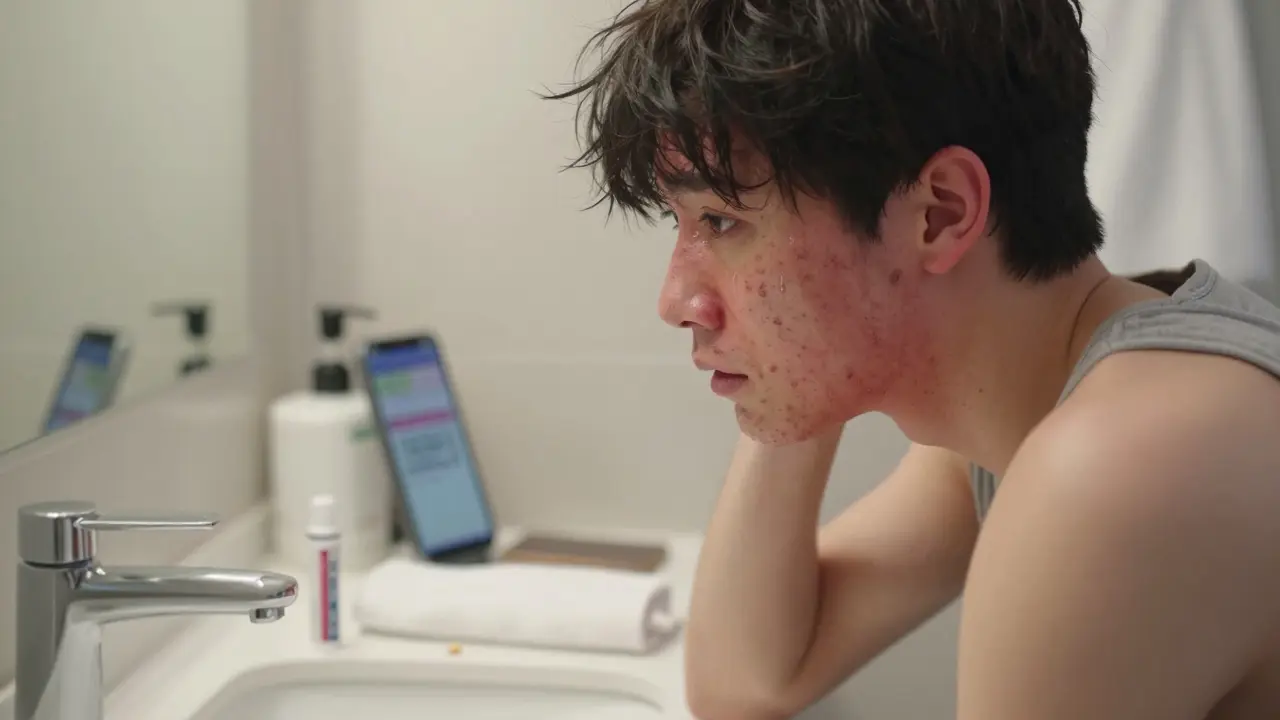
When your skin won’t respond to creams, antibiotics, or even hormonal treatments, and cysts keep forming under your cheeks and jawline, you’re not just dealing with acne-you’re dealing with a condition that affects your confidence, your sleep, and your daily life. That’s where isotretinoin comes in. It’s not the first thing you try. But for severe nodular or cystic acne that refuses to fade, it’s often the only thing that works.
How Isotretinoin Actually Works
Isotretinoin doesn’t just treat acne-it rewires the system that causes it. Unlike topical treatments that sit on the surface, this oral medication targets the root problem: your sebaceous glands. These oil-producing glands in your skin become overactive in acne-prone individuals, clogging pores and creating the perfect environment for bacteria to thrive. In clinical studies, isotretinoin shrinks these glands by up to 90%. That means less oil, fewer clogged pores, and less inflammation. It also normalizes how skin cells shed, so they don’t stick together and block follicles. And because it cuts off the bacteria’s food supply (sebum), Cutibacterium acnes-the main acne culprit-struggles to survive. The result? About 80% of people who finish a full course see their acne stay clear for years, sometimes permanently. That’s far better than topical retinoids (30-40% success), oral antibiotics (50-60%), or birth control pills (60-70%). For many, it’s the first time in years their skin feels truly under control.Lab Monitoring: What You Need to Check
Isotretinoin is powerful. That’s why doctors don’t just hand out prescriptions. Before you start, you’ll need baseline blood tests:- Complete Blood Count (CBC) - checks for any hidden blood disorders
- Liver enzymes (ALT, AST) - monitors for rare liver stress
- Lipid panel - measures cholesterol and triglycerides, which can rise during treatment
Dosing: High vs. Low, What Works Best
There’s no one-size-fits-all dose. Traditionally, doctors prescribed 0.5 to 1.0 mg per kilogram of body weight per day. For a 70 kg person, that’s 35-70 mg daily. But newer research shows you don’t always need that much. A 2023 review of 32 studies found that a low-dose protocol-just 0.5 mg/kg every other day, or even 20 mg daily for three months-worked just as well for many people with moderate to severe acne. One NIH study reported 90% improvement with 20 mg/day for three months, and only 4% of patients saw acne return within six months. The goal is to reach a total cumulative dose of 120-150 mg/kg over the course of treatment. That usually takes 5 to 8 months. Some patients need longer, especially if their acne is very severe or they’ve had it for years. The big advantage of lower doses? Fewer side effects. Dry lips, nosebleeds, and eye dryness still happen-but they’re often milder. Many patients find they can stick with treatment longer when the side effects are manageable.
Safety: The Risks You Can’t Ignore
Isotretinoin has a black box warning-the strongest one the FDA gives. It can cause severe birth defects. That’s why, in the U.S., every patient must enroll in the iPLEDGE program. For women of childbearing potential, that means:- Two negative pregnancy tests before starting
- Monthly pregnancy tests during treatment
- Two forms of birth control at the same time
- Waiting one full month after stopping before trying to get pregnant
- Dry lips - happens in 90% of users. Use petroleum jelly (Vaseline) 5-10 times a day.
- Dry eyes - 25-30% of people. Artificial tears help.
- Nosebleeds - 15-20%. Keep the inside of your nose moist with saline spray.
- Skin peeling - use gentle, fragrance-free moisturizers.
- Elevated triglycerides - can lead to pancreatitis if unchecked
- Pseudotumor cerebri - severe headaches, blurred vision, nausea. Stop the drug and call your doctor immediately.
- Depression - the link is controversial. Studies show a 0.1% incidence. Still, if you feel unusually sad, hopeless, or withdrawn, tell your doctor.
- Inflammatory bowel disease - extremely rare (0.02% risk)
Real Results: What Patients Actually Experience
People who’ve been through it say the same thing: “It changed my life.” One Reddit user, u/SkinClearJourney, wrote: “At 40mg daily for 5 months, I went from constant cysts to 90% clear. My lips were cracked, but I used Vaseline constantly. Worth every day.” Another, u/AcneStruggles89, shared: “I got 70% better, but then I got severe joint pain. I had to stop at week 10. It was heartbreaking.” Clinical trials show 85-90% satisfaction among those who complete treatment. The psychological boost is huge. People report going back to social events, wearing makeup again, or even applying for jobs they avoided because of their skin. But it’s not magic. Some people relapse. About 10-20% need a second course, usually at a lower dose. A few develop permanent dry skin or eye issues-but these are uncommon.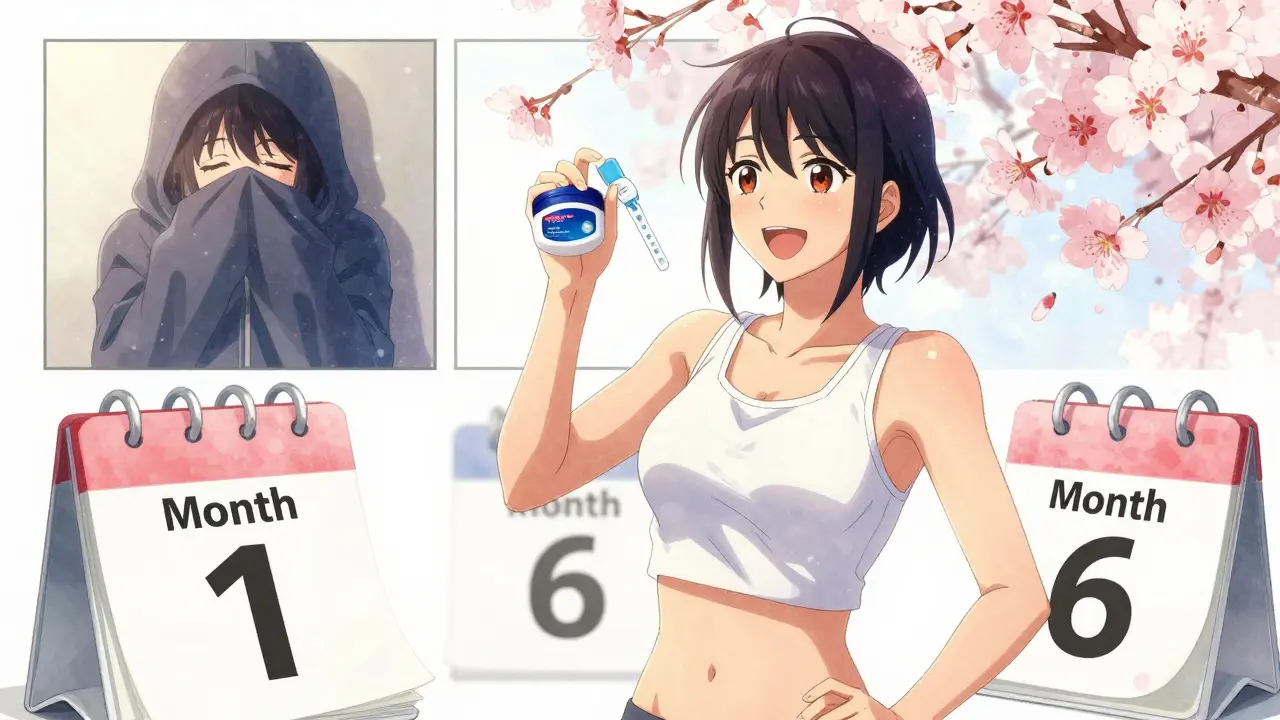
Is Isotretinoin Right for You?
It’s not for mild acne. If you have a few blackheads or occasional pimples, start with topical treatments. Isotretinoin is for:- Deep, painful cysts
- Nodules that don’t heal
- Acne that’s lasted years and didn’t respond to other treatments
- Scarring that’s already forming
What Comes After?
After you finish, your skin won’t instantly be perfect. It can take 2-3 months for inflammation to fully calm down. Some people need to keep using a gentle moisturizer or low-dose topical retinoid to maintain results. You won’t need monthly blood tests anymore. But if your acne comes back, don’t panic. Many people go on a second course, and it’s often even more effective the second time around. The key is patience. This isn’t a quick fix. It’s a reset button for your skin. And for those who stick with it, the payoff is often life-changing.How long does isotretinoin take to work?
Most people see improvement within 4 to 8 weeks, but full results usually take 5 to 8 months. Some experience an initial flare in the first few weeks-this is normal and often followed by rapid clearing.
Can isotretinoin cause permanent dry skin?
Permanent dry skin is rare. Most people find their skin returns to normal within a few months after stopping. However, some report lingering dryness, especially around the lips or eyes. Ongoing use of gentle moisturizers and lip balms can help manage this.
Do I need to avoid the sun while on isotretinoin?
Yes. Isotretinoin increases sun sensitivity. You’re more likely to burn easily. Use broad-spectrum SPF 30+ daily, even on cloudy days, and wear hats or protective clothing. Avoid tanning beds entirely.
Can I drink alcohol while taking isotretinoin?
It’s best to avoid or limit alcohol. Both isotretinoin and alcohol are processed by the liver. Combining them increases the risk of liver stress. Even moderate drinking can raise triglyceride levels, which isotretinoin already affects.
Is isotretinoin the same as Accutane?
Yes, isotretinoin is the generic name for the drug once sold under the brand name Accutane. Accutane was discontinued in 2009 due to legal issues, but generic versions are now widely available and work identically.
How much does isotretinoin cost?
Generic isotretinoin costs between $150 and $400 for a 30-day supply, depending on dosage and pharmacy. Insurance often covers it, especially if you’re enrolled in iPLEDGE. Some pharmacies offer discount programs for uninsured patients.

Tony Du bled
December 22, 2025 AT 22:13Been on it for 6 months. Lips are cracked like a desert, but my skin? Finally human. Worth every damn day.
jenny guachamboza
December 24, 2025 AT 06:49lol they say it's safe but have you seen the iPLEDGE portal?? it's like the government's way of making you suffer before you heal 😅
Cara Hritz
December 24, 2025 AT 17:42you forgot to mention the joint pain. i got it at week 8. doc said it was 'probably unrelated' but i still think it was the isotretinoin. my knees still crack in the morning. 🤷♀️
Aliyu Sani
December 26, 2025 AT 16:02the real question isn't whether it works-it's whether we're willing to trade our bodies for clarity. we treat acne like a cosmetic flaw, but it's a symptom of a system out of sync. isotretinoin doesn't cure acne-it silences the noise. but at what cost to the soul?
we don't ask why our glands go rogue. we just pump chemicals into them. we've forgotten how to listen to skin. we only want it gone.
maybe the answer isn't more drugs. maybe it's less stress, less dairy, less screen glow at 2am. but no one wants to hear that. too slow. too human.
still... i'm glad it exists. for those who need it. not for the influencers. not for the beauty standards. for the ones who can't sleep because their face feels like a war zone.
Kiranjit Kaur
December 28, 2025 AT 12:20my cousin finished isotretinoin last year and now she’s glowing like she just got back from a spa retreat 🌟 i was skeptical but now i’m telling all my acne-struggling friends to talk to a derm. you’re not weak for needing this-you’re brave for sticking with it 💪❤️
Sai Keerthan Reddy Proddatoori
December 29, 2025 AT 23:09why do americans think pills fix everything? in my country we use turmeric and neem. clean. natural. no black box warnings. this drug is a corporate scam wrapped in a prescription
Johnnie R. Bailey
December 31, 2025 AT 10:37as someone who’s prescribed this to over 200 patients, let me say this: the fear around isotretinoin is way out of proportion to the actual risk. yes, you need labs. yes, you need iPLEDGE. but the real tragedy isn’t the side effects-it’s the people who don’t start because they’re scared of a 0.02% chance of IBD.
the acne they live with? That’s the real chronic disease. The dry lips? Temporary. The shame? That lingers.
i’ve seen kids go from hiding in hoodies to graduating, dating, applying for jobs-all because they finally had a chance. don’t let bureaucracy scare you out of your life.
Art Van Gelder
January 1, 2026 AT 17:31so let me get this straight-you take a drug that shrinks your oil glands by 90%, forces you to take two forms of birth control if you’re female, gets you monthly blood draws, makes your lips feel like sandpaper, and then you’re supposed to feel grateful because your face isn’t covered in pus-filled volcanoes anymore?
it’s like winning the lottery by surviving a plane crash.
and yet... i get it. i’ve been there. i remember staring at my reflection at 2am wondering if my face was the only thing people saw. if my soul was invisible behind the cysts.
isotretinoin doesn’t fix your skin. it gives you back the right to be seen. and sometimes? that’s worth every damn side effect.
but don’t let anyone tell you it’s easy. it’s not. it’s brutal. and it’s beautiful.
and yes, i still use Vaseline like it’s oxygen.
Kathryn Weymouth
January 2, 2026 AT 17:00Minor correction: the 2023 review included 34 studies, not 32. Also, the cumulative dose threshold is typically 120–150 mg/kg, but some newer protocols suggest 100–120 mg/kg may be sufficient for mild-to-moderate cases with lower relapse rates. Source: Journal of the American Academy of Dermatology, 2023;88(3):678-689.
Nader Bsyouni
January 3, 2026 AT 17:57isotretinoin is just the pharmaceutical industry’s way of monetizing insecurity. you think your skin is the problem? it’s the culture that told you it was. stop taking pills. start questioning the mirror
Julie Chavassieux
January 3, 2026 AT 21:44my dermatologist said i had to wait 3 months just to get my first iPLEDGE appointment... then i had to do two pregnancy tests... then i had to sign seven forms... then i had to wait another two weeks for the prescription... and then i got the first bottle and it was expired??
it’s not treatment. it’s a ritual of suffering
Jeremy Hendriks
January 5, 2026 AT 05:43you know what’s worse than isotretinoin? the people who say ‘just wash your face’ or ‘it’s just acne’ like it’s a fashion choice. you don’t know what it’s like until you’ve cried in the shower because your skin looks like a crime scene. this drug saved my life. end of story.