
MAOI Medication Safety Checker
Check Medication Safety
Enter an OTC medicine name or ingredient to see if it's safe with MAOIs (monoamine oxidase inhibitors)
Examples: Sudafed, DayQuil, Robitussin, Mucinex, Tylenol
Safe OTC Alternatives
For symptoms when taking MAOIs:
- Congestion Saline nasal spray
- Cough Guaifenesin (Mucinex)
- Pain/Fever Acetaminophen (Tylenol)
Important Washout Period
Wait at least 14 days after stopping any MAOI before taking cold medicines containing:
- Pseudoephedrine, Phenylephrine, Ephedrine
- Dextromethorphan (DM)
This is because MAOIs irreversibly block enzymes and your body needs time to produce new ones.
When you're sick with a cold or flu, reaching for an over-the-counter remedy feels like a simple fix. But if you're taking a monoamine oxidase inhibitor (MAOI) for depression, that cough syrup or nasal spray could trigger a medical emergency. The combination of MAOIs and common OTC cold medicines can cause hypertensive crisis or serotonin syndrome-two life-threatening conditions that require immediate medical attention. This isn't a rare edge case. Between 2018 and 2022, the FDA documented 127 cases of hypertensive crisis linked to MAOI and OTC drug interactions, with 18 requiring hospitalization. These aren't theoretical risks-they're real, documented dangers that still catch people off guard.
How MAOIs Work (And Why They're Dangerous With Cold Meds)
MAOIs like phenelzine (Nardil), tranylcypromine (Parnate), and isocarboxazid (Marplan) work by blocking the enzyme monoamine oxidase. This enzyme normally breaks down neurotransmitters like serotonin, norepinephrine, and dopamine. By stopping its job, MAOIs boost these chemicals in the brain, which helps lift mood in people with treatment-resistant depression. But this same mechanism becomes dangerous when combined with certain OTC medications.
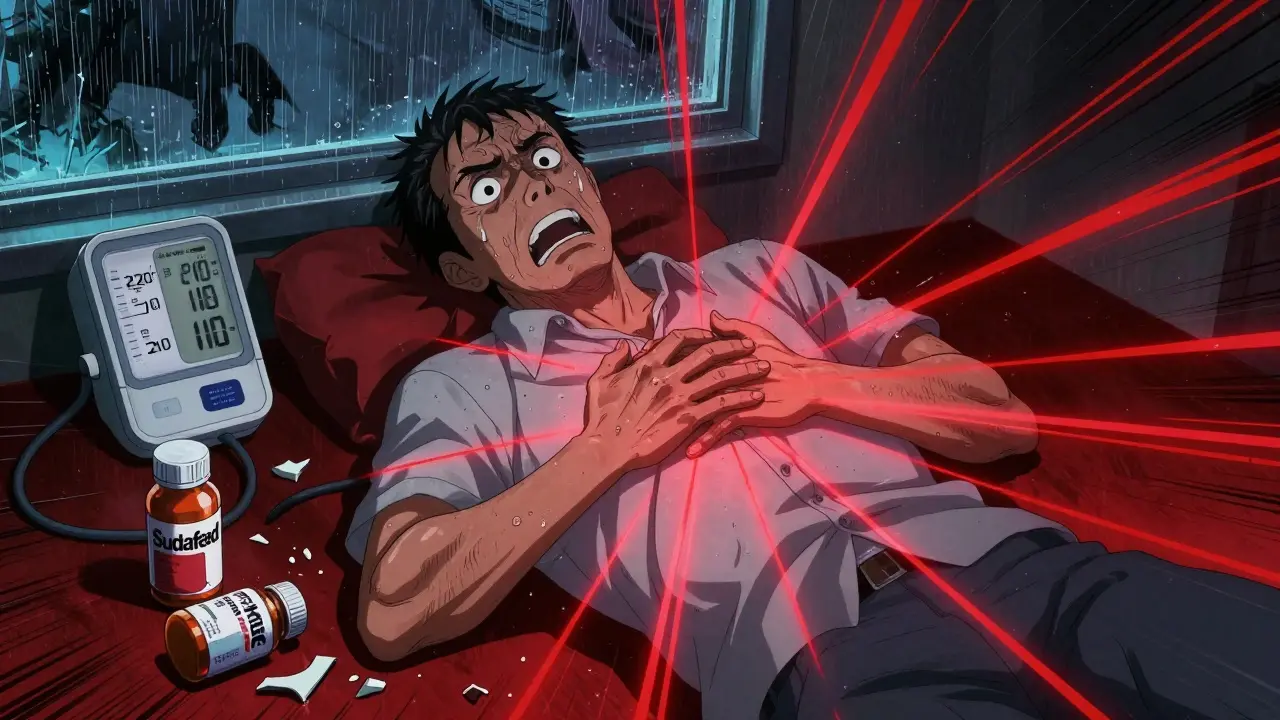
Many cold and flu products contain sympathomimetic agents-drugs that mimic the effects of adrenaline. Common ones include pseudoephedrine (found in Sudafed), phenylephrine (Sudafed PE), and ephedrine. These compounds cause your body to release even more norepinephrine. Normally, your body breaks down the excess. But when you're on an MAOI, that breakdown process is shut down. The result? A runaway surge of norepinephrine that spikes your blood pressure to dangerous levels. Systolic readings above 200 mmHg aren't unusual in these cases. One Reddit user reported a blood pressure of 220/110 after taking Sudafed with Parnate. That's a hypertensive emergency.
The Hidden Danger: Dextromethorphan and Serotonin Syndrome
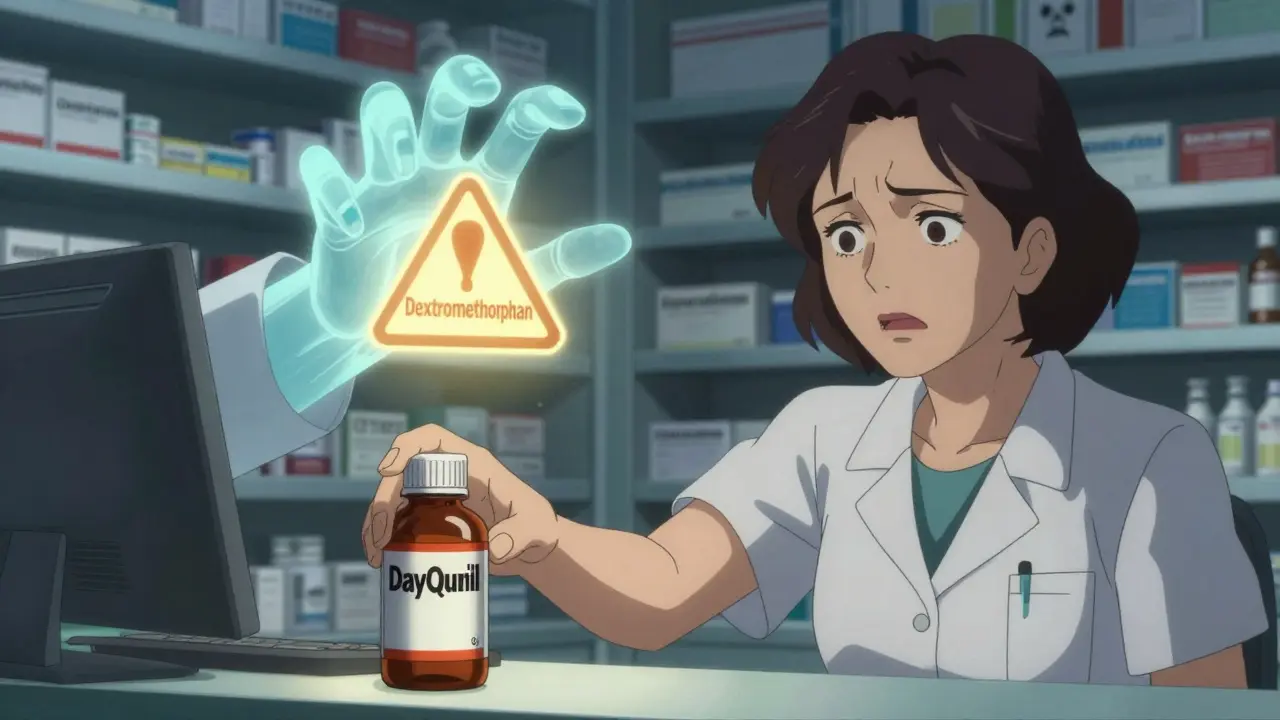
Another common OTC ingredient, dextromethorphan (found in Robitussin DM, Delsym, and DayQuil), is often overlooked. It's not a decongestant-it's a cough suppressant. But it also increases serotonin levels in the brain. When taken with an MAOI, which already prevents serotonin breakdown, the combination can push serotonin far beyond safe limits. This leads to serotonin syndrome: a condition marked by confusion, rapid heart rate, high fever, muscle rigidity, tremors, and in severe cases, seizures or death.
The NCBI Bookshelf (StatPearls, 2023) calls this the "most toxic combination" for serotonin syndrome. Even a single dose of dextromethorphan can trigger symptoms in someone on an MAOI. A user on Psych Forums described 12 hours of severe headache, neck stiffness, and palpitations after taking DayQuil with Nardil. It wasn't fatal, but it was terrifying-and it could have been worse.
What OTC Medicines Are Safe? What’s Not?
Not all cold medicines are off-limits. The problem isn’t the illness-it’s the ingredients. Here’s what to avoid:
- Decongestants: Pseudoephedrine, phenylephrine, ephedrine, phenylpropanolamine (banned in the U.S. but still found in some foreign products)
- Cough suppressants: Dextromethorphan (any product labeled "DM" or "Delsym")
- Multisymptom formulas: DayQuil, NyQuil, TheraFlu, Zicam Cold Remedy, and similar products often contain multiple risky ingredients
Safe alternatives exist. For congestion, try saline nasal spray or a humidifier. For pain or fever, acetaminophen (Tylenol) is generally safe. For cough, guaifenesin (Mucinex) is the only expectorant without known interaction risks. Always check the active ingredients list-not just the brand name. A 2023 US Pharmacist study found that 78% of OTC cold medications contain at least one ingredient dangerous for MAOI users.
Why This Risk Is Worse Than With Other Antidepressants
SSRIs and SNRIs can also cause serotonin syndrome with dextromethorphan-but they don’t cause hypertensive crisis with decongestants. MAOIs are unique. Most are irreversible inhibitors, meaning they permanently disable the monoamine oxidase enzyme. Your body can’t just "catch up"-it takes weeks for new enzymes to be made. That’s why psychiatrists require a 14-day washout period before switching from an MAOI to another antidepressant. Even the transdermal selegiline patch (Emsam), which has fewer dietary restrictions, carries the same drug interaction risks as oral MAOIs. There’s no safe exception.
Real Stories, Real Consequences
These aren’t hypotheticals. In 2021, a 52-year-old woman in Ohio was rushed to the ER after taking Sudafed PE while on phenelzine. Her blood pressure hit 210/108. She needed IV medication to bring it down. Another case from 2020 involved a man who took Robitussin DM with Parnate. He developed a fever of 104°F, muscle rigidity, and confusion. He survived-but only after intensive care.
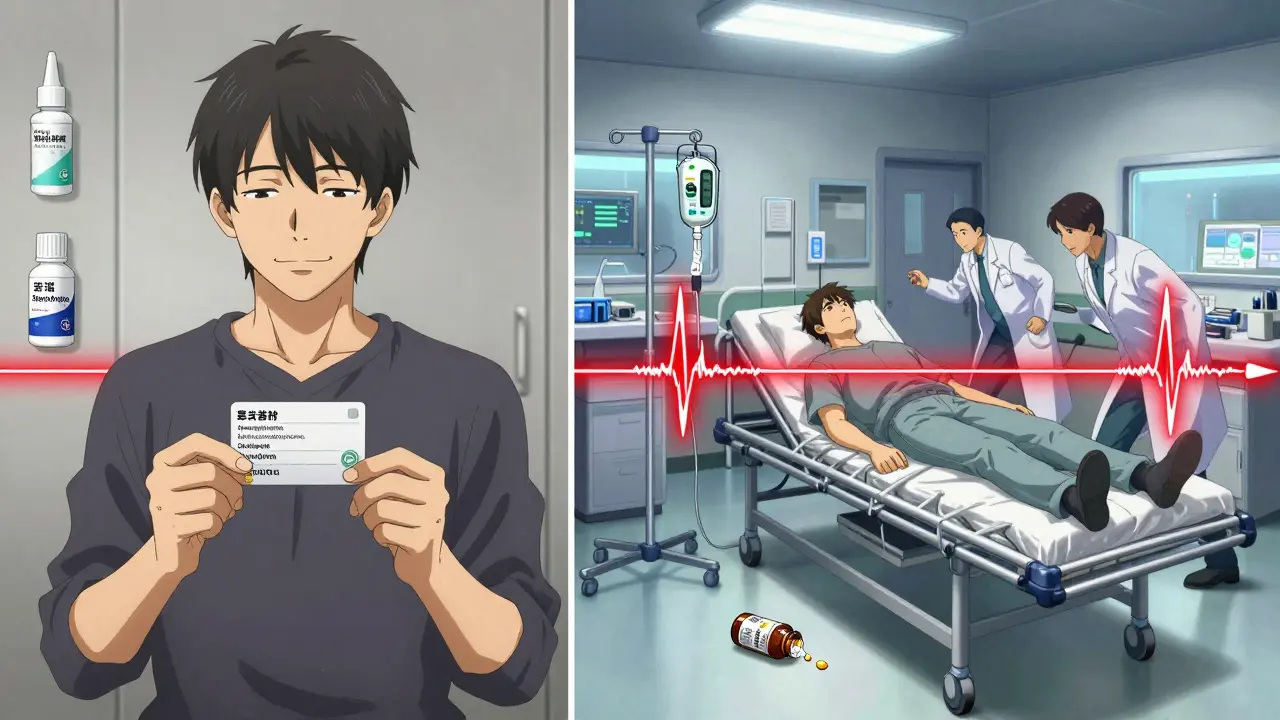
On the flip side, people who take precautions report better outcomes. One patient on PatientsLikeMe shared that their psychiatrist gave them a wallet-sized card listing every forbidden OTC product. They’ve used it for five years and never had an issue. Simple tools like that make a huge difference.
What You Should Do Right Now
If you’re on an MAOI, here’s what to do immediately:
- Review every OTC medicine in your cabinet. Look for pseudoephedrine, phenylephrine, or dextromethorphan.
- Get a list of safe alternatives. Your pharmacist can give you one. Ask for guaifenesin for cough, acetaminophen for pain, and saline sprays for congestion.
- Carry a medication card. Print or write down your MAOI and list the dangerous ingredients. Keep it in your wallet.
- Warn family members. Someone else might pick up a cold medicine for you without knowing the risk.
- Don’t assume "natural" or "herbal" is safe. Some supplements like St. John’s Wort or 5-HTP also raise serotonin and can be dangerous.
Even if you’ve been on an MAOI for years without incident, one wrong OTC pill can change everything. The FDA updated its black box warning on MAOIs in 2019 to emphasize this risk. It’s not outdated advice-it’s current, critical, and life-saving.
What’s Changing? What’s Next?
MAOI use has dropped sharply since the 1990s, from 1.2 million users in 2000 to just 350,000 today. But they’re still vital for people who don’t respond to SSRIs or SNRIs. In specialized clinics, up to 20% of antidepressant prescriptions are for MAOIs because they work where others fail.
There’s hope on the horizon. A new reversible MAO-A inhibitor called CX-1010 is in Phase II trials (NCT04567812) and may offer similar benefits without the dangerous interactions. But until then, the rules haven’t changed. The safest choice is still avoiding OTC cold medicines entirely unless you’ve confirmed every ingredient with your doctor or pharmacist.
Can I take Tylenol while on an MAOI?
Yes, acetaminophen (Tylenol) is generally safe to use with MAOIs. It doesn’t affect serotonin or norepinephrine levels and has no known interaction with these antidepressants. It’s one of the few pain relievers recommended for MAOI users. Avoid NSAIDs like ibuprofen or aspirin if you have other health conditions, but for most people, Tylenol is the safest OTC pain and fever option.
Is it safe to use nasal sprays with MAOIs?
Topical nasal decongestant sprays like oxymetazoline (Afrin) are considered lower risk than oral versions, but they’re not risk-free. Some studies show they can still cause small but measurable increases in blood pressure in MAOI users. The safest approach is to avoid all decongestants, even nasal sprays. Use saline sprays instead. If you must use a nasal spray, talk to your doctor first and monitor your blood pressure closely.
What if I accidentally take a dangerous cold medicine?
If you take a medication containing pseudoephedrine, phenylephrine, or dextromethorphan while on an MAOI, seek medical help immediately. Symptoms of hypertensive crisis include severe headache, blurred vision, chest pain, nausea, and anxiety. Serotonin syndrome symptoms include confusion, rapid heartbeat, high fever, muscle stiffness, and tremors. Don’t wait. Call 911 or go to the ER. These reactions can escalate quickly and are life-threatening.
Do all MAOIs have the same interaction risks?
Yes. Whether you’re on phenelzine, tranylcypromine, isocarboxazid, or the selegiline patch, the interaction risks with OTC cold medicines are the same. The transdermal patch reduces dietary tyramine restrictions, but it does not reduce the risk of hypertensive crisis or serotonin syndrome from OTC drugs. All MAOIs inhibit monoamine oxidase in the same way. Never assume one form is safer than another when it comes to drug interactions.
How long should I wait after stopping an MAOI before taking OTC cold medicine?
Wait at least 14 days after stopping any MAOI before taking any OTC cold medicine containing dextromethorphan, pseudoephedrine, or phenylephrine. This is because most MAOIs irreversibly block the enzyme, and it takes about two weeks for your body to produce new enzymes. Even if you feel fine, the risk of interaction remains. Don’t rely on how you feel-rely on the timeline. If you’re switching to another antidepressant, your doctor will guide you through this washout period.



Amadi Kenneth
March 16, 2026 AT 21:48Laura Gabel
March 16, 2026 AT 22:50jerome Reverdy
March 18, 2026 AT 07:58Andrew Mamone
March 18, 2026 AT 13:29Srividhya Srinivasan
March 19, 2026 AT 18:21Stephen Habegger
March 20, 2026 AT 14:47Justin Archuletta
March 20, 2026 AT 18:27Sanjana Rajan
March 20, 2026 AT 19:03