
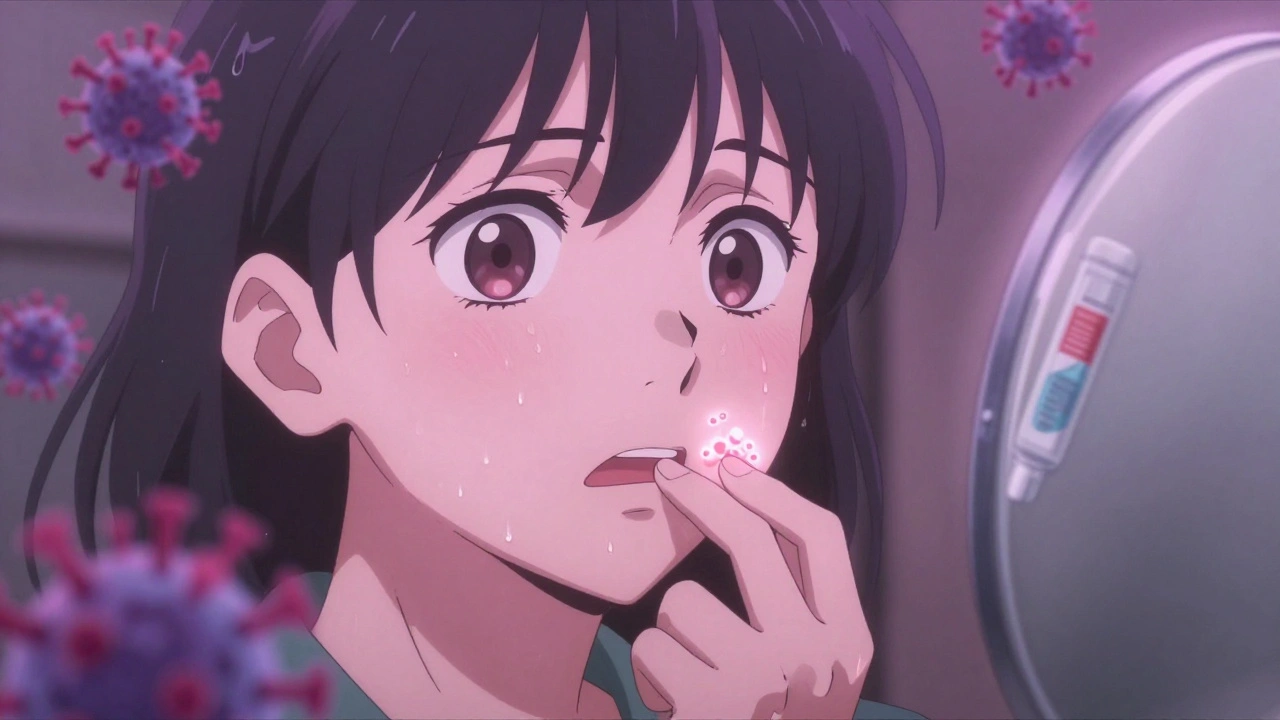
Ever looked in the mirror and seen a tiny bump on your lip and thought, ‘Is this a pimple or a cold sore?’ You’re not alone. Thousands of people confuse these two every day - and the mistake can make things worse. Cold sores and pimples look similar at first glance: red, sometimes swollen, and often painful. But they’re completely different conditions. One is viral and contagious. The other is a blocked pore. Treating them the wrong way can spread infection, delay healing, or even leave scars.
What Exactly Is a Cold Sore?
A cold sore is caused by the herpes simplex virus type 1 (HSV-1). It’s not rare - about 67% of people under 50 worldwide carry it, according to the World Health Organization. Most people get infected as kids, often through a kiss or sharing a cup. Once you have the virus, it stays in your body for life. It doesn’t go away, but it can stay quiet for months or years.
When it wakes up, you’ll feel it before you see it. That’s the key. A tingling, burning, or itching sensation on your lip - usually 12 to 48 hours before anything shows up. That’s your warning sign. Then, small fluid-filled blisters appear, often in a cluster. They’re not one big bump. They’re three to five tiny ones grouped together, right at the edge where your lip meets your skin. That’s the classic sign.
The blisters break open, ooze clear fluid that turns cloudy, then crust over into a yellowish scab. Healing takes 7 to 14 days without treatment. But if you catch it early - right when it starts tingling - antiviral creams like acyclovir or penciclovir can cut that time down to 5 to 7 days. Prescription pills like valacyclovir work even faster if taken within the first 24 hours.
What Exactly Is a Pimple?
Pimples are acne. They happen when your skin’s oil glands get clogged with dead skin cells and bacteria - mainly Cutibacterium acnes. Your face has hair follicles everywhere, even on your lips. That’s why pimples can pop up right on the lip surface, not just around it.
Unlike cold sores, pimples don’t come with a warning. No tingling. No burning. Just a red bump that gets tender to the touch. It might have a white or yellow head - that’s pus, not fluid. It’s not contagious. You can’t catch a pimple from someone else. It’s not an infection you spread. It’s your own skin reacting to blockage.
Minor pimples heal in 3 to 7 days. Cystic ones, the deep, painful ones under the skin, can last weeks. Treatment is about clearing pores and killing bacteria. Topical benzoyl peroxide (2.5% to 10%) kills the bacteria and reduces inflammation. Salicylic acid (0.5% to 2%) helps peel away dead skin so pores don’t get clogged again. You need to use these daily, not just when a pimple appears.
How to Tell Them Apart - The 3-Minute Test
Here’s how to tell them apart fast:
- Location: Cold sores? Always on the lip border - the thin edge where your lip meets your face. Pimples? Can be anywhere: forehead, chin, nose, even the lip surface itself.
- Sensation: Cold sores start with tingling, itching, or burning. Pimples? Just pain when you touch them. No warning.
- Appearance: Cold sores are clusters of tiny blisters. Pimples are single bumps, sometimes with a white head. One big bump? Probably a pimple. A group of small blisters? Almost certainly a cold sore.
Still unsure? Take a photo. Compare it to images from trusted sources like the American Academy of Dermatology. Don’t guess. Misdiagnosis leads to mistakes.

Why Treating Them Wrong Makes Things Worse
Applying acne cream to a cold sore is a common error. Benzoyl peroxide, salicylic acid, or alcohol-based spot treatments can dry out and burst the blisters. That doesn’t speed up healing. It spreads the virus. HSV-1 is highly contagious during an active outbreak. You can infect your own eyes, fingers, or other people - especially kids - by touching the sore then touching something else.
Reddit users report that 68% of first-time cold sore sufferers thought it was a pimple and popped it. That’s how many end up with multiple sores or even a spread to the nose or chin. One woman in a SkincareRx forum applied toothpaste to her cold sore - a popular home remedy - and ended up with a raw, irritated patch that took three weeks to heal.
On the flip side, using antiviral cream on a pimple does nothing. It’s like using insulin for a headache. You waste money and delay the right treatment.
What Actually Works - Proven Treatments
For cold sores:
- Start antiviral cream (acyclovir, penciclovir, or docosanol) at the first tingle. Apply every 2 hours while awake for 4 days.
- Prescription pills like valacyclovir (Valtrex) taken within 24 hours of symptoms can shorten outbreaks by 1 to 2 days.
- Over-the-counter docosanol (Abreva) reduces healing time by about half - but only if used consistently for 4 to 5 days.
- Don’t pick, pop, or peel the scab. Let it fall off naturally.
For pimples:
- Benzoyl peroxide 2.5% - apply once daily. It’s just as effective as 10% but less irritating.
- Salicylic acid 0.5% to 2% - use in cleansers or toners to prevent clogged pores.
- Non-comedogenic moisturizers and sunscreens - avoid anything that clogs pores.
- Don’t touch or squeeze. That pushes bacteria deeper and causes scarring.
How to Prevent Them
Cold sores: Outbreaks are triggered. Know your triggers.
- UV exposure - 32% of outbreaks. Use SPF 30+ lip balm daily, even in winter.
- Stress - 28%. Practice sleep, breathing, or walks. Stress weakens your immune system.
- Hormonal changes - 19%. Many women get outbreaks before their period.
- Illness or fatigue - 15%. Rest when you’re run down.
Don’t share lip balm, utensils, or towels during an outbreak. Wash your hands after touching your lip. If you have a cold sore, avoid kissing babies - their immune systems can’t fight HSV-1.
Pimples: Prevention is daily work.
- Cleanse gently twice a day. Over-washing dries skin and makes oil production worse.
- Don’t use harsh scrubs. They irritate and trigger more breakouts.
- Change pillowcases twice a week. Oil and bacteria build up.
- Remove makeup before bed. Even ‘non-comedogenic’ products can clog if left on.

When to See a Doctor
See a dermatologist if:
- Your cold sore doesn’t heal in 2 weeks.
- You get frequent outbreaks (more than 5 times a year).
- The sore spreads to your eyes, nose, or fingers.
- Your pimple is deep, painful, or leaves scars.
- Over-the-counter acne treatments don’t work after 8 weeks.
New treatments are emerging. In 2023, the FDA approved pritelivir - an experimental antiviral that reduces viral shedding by 70%. For acne, microbiome-friendly products are now available that kill bad bacteria without wiping out the good ones.
Common Mistakes to Avoid
- Using toothpaste, baking soda, or vinegar on cold sores - these burn and delay healing.
- Sharing lip products during an outbreak - transmission risk jumps to 41%.
- Applying acne spot treatments to cold sores - 72% of users report increased pain and blister rupture.
- Waiting until the sore is visible to treat it - the best window is the tingling stage.
- Thinking one treatment fixes both - they’re not interchangeable.
Don’t treat your lip like a science experiment. Use the right tool for the right problem.
Can a cold sore turn into a pimple?
No. A cold sore is caused by a virus and follows a specific healing cycle. A pimple is a blocked pore. They’re two different conditions. What might look like a pimple forming on a cold sore is usually just the blister breaking open and scabbing - not a new pimple. Don’t confuse the stages of a cold sore with acne.
Can you get a pimple on your lip?
Yes. The lip surface has hair follicles, so pimples can form right on the edge of your lip. These are often mistaken for cold sores, especially if they’re red and swollen. But if there’s no tingling before it appears, and it’s a single bump with a white head, it’s likely a pimple.
Is it safe to pop a cold sore?
Never pop a cold sore. The fluid inside is full of active virus. Popping it spreads the infection to nearby skin or to other people. It also increases healing time by 3 to 5 days and raises the risk of scarring or secondary infection. Let it heal naturally.
Can stress cause cold sores?
Yes. Stress is one of the top triggers, responsible for nearly 28% of outbreaks. When you’re stressed, your immune system slows down, letting the dormant herpes virus reactivate. Managing stress through sleep, exercise, or mindfulness can reduce how often you get cold sores.
Can I use the same lip balm for cold sores and pimples?
No. If you have an active cold sore, use a fresh, disposable applicator or a new tube of lip balm. Sharing or reusing the same product can spread the virus. For pimples, choose a non-comedogenic balm - one that won’t clog pores. Keep them separate.
Final Tip: Know Your Skin
Track your outbreaks. Keep a simple log: when they happen, what you were doing, how you felt. Over time, you’ll spot patterns - maybe you get them after sun exposure or during exams. That’s power. You can prevent them before they start. For pimples, notice what products make them worse. Maybe it’s your foundation, your pillowcase, or your stress levels.
Don’t treat your skin like a mystery. Learn the signs. Use the right tools. And if you’re ever unsure - see a dermatologist. It’s faster, cheaper, and safer than guessing.

Jamie Clark
December 13, 2025 AT 09:08Let’s be real - most people don’t care about the difference until they’ve already popped a cold sore with toothpaste and now their whole face looks like a crime scene. This post isn’t just informative, it’s a public service announcement disguised as skincare advice. Stop treating your lips like a science fair project.
Alvin Montanez
December 13, 2025 AT 22:06It’s appalling how many people still believe in home remedies for HSV-1. Toothpaste? Baking soda? Vinegar? These aren’t fixes - they’re acts of self-sabotage wrapped in internet folklore. The fact that 72% of users report increased pain after misapplying acne treatments proves we’ve collectively regressed as a society. We have access to peer-reviewed antivirals, yet we Google ‘cold sore cure’ and end up with a 1998 Yahoo Answers thread. Shameful. And don’t even get me started on the ‘I don’t believe in viruses’ crowd who think this is just ‘bad luck’ or ‘toxins.’ Wake up. It’s herpes simplex virus type 1. It’s not a moral failing. It’s biology. Treat it like it.
And yes, I’ve had five outbreaks in the last year. I know what I’m talking about. I stopped touching my face. I started using SPF 50 lip balm daily. I carry valacyclovir in my wallet. I don’t apologize for being this meticulous. If you’re going to live with a lifelong virus, you owe it to yourself - and everyone you kiss - to be responsible.
Also, if you think stress doesn’t trigger outbreaks, you’ve never had a panic attack before a job interview and then woken up with a blister on your upper lip. It’s not coincidence. It’s immunology. Your body’s under siege, and HSV-1 takes the opportunity to throw a party. Stop blaming your diet. Start managing your cortisol.
And for the love of all that’s holy, don’t share lip balm. Ever. Not even with your partner. Use a fresh tube. Wash your hands. Don’t kiss babies. I’m not being dramatic. I’m citing CDC data. HSV-1 in neonates has a 50% mortality rate if untreated. You think that’s an exaggeration? Look it up. Then stop being lazy.
This isn’t about acne. This isn’t about beauty. This is about public health. And we’re failing.
Keasha Trawick
December 14, 2025 AT 16:50Okay but imagine your lip suddenly going full ‘alien hive’ - tiny blisters like microscopic jellyfish colonies erupting outta nowhere. That’s a cold sore. A pimple? That’s just your skin screaming ‘I’ve had enough of this foundation and your 3 a.m. snack runs.’ One’s a viral rave. The other’s a clogged pore tantrum. You don’t treat a rave with a pore strip. You don’t throw antivirals at a zit like it’s a bad roommate. 🤯
And the tingling? Ohhh honey, that’s the virus whispering ‘I’m back, bae’ like a toxic ex showing up at your birthday. You feel it. You know it. And if you don’t act in that 12-hour window? Congrats, you just signed up for a two-week facial sculpture project.
Also, why is toothpaste still a thing? Is someone out there writing a TikTok script titled ‘I put Colgate on my herpes and now I’m a saint’? No. No one’s a saint. You’re just a person with a raw, burning lip and a 300% chance of scarring.
PS: I used docosanol at the first tingle and it saved my entire Valentine’s Day. No kissing? Fine. No herpes face? Priceless.
Webster Bull
December 15, 2025 AT 16:57Just caught the tingle. Applied acyclovir. Done. No drama. No popping. No toothpaste. Just science. You got this.
Emma Sbarge
December 17, 2025 AT 11:55I don’t care how many studies you cite - if you’re telling me I can’t use a dab of Neosporin on a pimple that’s been bothering me for three days, you’re not helping. And why are you acting like cold sores are some kind of moral failure? My grandma had them since she was 12. She never kissed anyone she didn’t love. That doesn’t make it less real. You’re scaring people into shame instead of helping them manage it.
Also, ‘don’t share lip balm’ - sure, fine. But if you’re married? Come on. We share everything. Toothbrushes. Towels. Why is this one thing sacred? You’re being extreme.
Tommy Watson
December 17, 2025 AT 18:29lol i just popped mine and now its worse. why is this so hard. why cant u just use hydrocortisone? i swear ppl overthink this. its just a bump. i got a zit on my lip last week and i thought it was herpes so i cried. then it went away. maybe i just have bad skin. or maybe im just dumb.
Donna Hammond
December 18, 2025 AT 06:44Thank you for this. I’ve been dealing with recurrent cold sores for 12 years and no one ever explained the tingling phase like this. I thought it was just ‘allergies’ or ‘dry lips.’ I started using penciclovir at the first sign - and honestly, it’s cut my outbreaks in half. I also started carrying SPF lip balm everywhere. Even in winter. Even indoors. My dermatologist said I’m now one of the most compliant patients she’s ever had. It’s not about being perfect. It’s about being consistent. Small steps. Daily habits. You don’t need to be a scientist. Just be careful.
And to the person who said ‘I share lip balm with my partner’ - you can still love someone without sharing a tube. Use separate ones. Label them. It’s not romantic to risk their health. It’s just careless.
Also - if you’re getting more than 5 outbreaks a year, see a doctor. There are suppressive therapies now. You don’t have to live like this.
Richard Ayres
December 19, 2025 AT 15:20This is a remarkably clear and well-structured guide. I appreciate the emphasis on distinguishing viral etiology from sebaceous obstruction - a distinction often blurred in popular media. The statistical references to WHO and FDA-approved treatments lend credibility, and the practical advice on prophylaxis (particularly UV protection and stress management) is both evidence-based and accessible. One might argue that the tone borders on alarmist, but given the contagious nature of HSV-1 and the prevalence of misinformation, a firm stance is arguably necessary. Kudos to the author for demystifying a condition that is too often stigmatized.
Karen Mccullouch
December 20, 2025 AT 03:48Ugh. I hate when people act like cold sores are some big secret. It’s herpes. Deal with it. I’ve had them since I was 8. I don’t hide them. I don’t apologize. I just treat them. And if you’re too scared to kiss someone because they had a cold sore once? That’s your problem. Not theirs. Stop being dramatic. Also, why are you so obsessed with ‘don’t share lip balm’? I’ve shared mine with my boyfriend for 7 years. We’re fine. You’re just scared of sex.
Also, I used toothpaste on mine once. It burned. So what? It went away. End of story. You people are too serious about lip bumps.
Himmat Singh
December 20, 2025 AT 08:06While the article presents a clinically accurate dichotomy between herpes simplex virus lesions and acne vulgaris, it is regrettably devoid of any consideration for the Ayurvedic or Traditional Chinese Medicine perspectives on cutaneous eruptions. In Ayurveda, such lesions are classified as 'Vidradhi' - a manifestation of aggravated Pitta dosha - and are often addressed through dietary moderation, cooling herbs such as neem and aloe vera, and detoxification protocols. To reduce the condition to a binary of antivirals versus benzoyl peroxide is not only reductionist, but culturally imperialistic. The global prevalence of HSV-1 is not a justification for Western pharmaceutical hegemony over holistic healing traditions.
Furthermore, the assertion that HSV-1 is 'incurable' is scientifically inaccurate. Viral latency is not synonymous with permanent infection; emerging research in CRISPR-based gene editing has demonstrated the potential for excision of latent HSV-1 from trigeminal ganglia in murine models. To declare the condition 'lifelong' without acknowledging experimental therapeutics is misleading.
kevin moranga
December 22, 2025 AT 07:51I used to freak out every time I got one of these. Thought I was cursed. Then I started tracking mine - turns out I get them every time I pull an all-nighter or eat too much pizza. Who knew? Now I just sleep more, stress less, and keep acyclovir in my nightstand. No drama. No shame. Just smart habits. You got this. Seriously.
And if you’re scared to tell your partner? Just say it. ‘Hey, I’ve got a cold sore coming on - wanna hold off on kissing for a few days?’ They’ll respect you more for it. Honest beats hiding.
Lara Tobin
December 22, 2025 AT 15:49I’ve had cold sores since I was a kid. I used to feel so gross about them. Like I was broken. Reading this made me feel seen. Thank you for explaining the tingling thing - I always thought it was just my lip being dry. I’m going to start using that SPF balm. And I promise I won’t pop them anymore. 💙
Scott Butler
December 22, 2025 AT 20:47Look, I don’t care what the WHO says. I’ve had 17 cold sores in my life. Only one ever looked like the pictures. The rest? Just red bumps. You’re overcomplicating this. If it hurts, put on Neosporin. If it doesn’t go away, see a doctor. Done. Stop making people feel guilty for having a little bump.
Deborah Andrich
December 23, 2025 AT 18:15My sister used to get cold sores every time she got her period. I didn’t know until she told me. We stopped sharing lip gloss. We started using separate tubes. We didn’t make a big deal. We just changed our habits. That’s all this is. Not a crisis. Not a shame. Just biology. And biology can be managed. You don’t need to be perfect. Just consistent. You’re not alone.
Sheldon Bird
December 24, 2025 AT 11:33One time I put ice on a cold sore and it felt amazing. Not a cure. But it helped. Also - if you’re using benzoyl peroxide on your face, make sure you’re not accidentally getting it on your lips. That’s how I got my first pimple on my lip. It wasn’t herpes. It was just acne creeping in. I switched to a non-comedogenic moisturizer and it vanished in 48 hours. Small changes. Big difference.
Alvin Montanez
December 25, 2025 AT 18:50And to the person who said ‘I share lip balm with my boyfriend’ - you’re not being romantic. You’re being reckless. HSV-1 transmission rates during active outbreaks are 41%. That’s not a gamble. That’s a guaranteed risk. If you love someone, you protect them. Not just with words. With actions. Separate tubes. Wash your hands. Don’t kiss when it’s active. That’s not fear. That’s care.